If you’ve ever looked up at a plane wing curving smoothly through the sky, or held a small, precision-built latch that keeps a cockpit door sealed mid-flight, you’ve interacted with parts that start life in stamping dies. As a die supplier, I don’t just ship tooling boxes to customers— I ship the thing that turns a flat sheet of metal into parts that can’t afford to fail. The aerospace industry’s demand for tight tolerances, lightweight materials, and consistent quality makes stamping dies way more than just a manufacturing tool; they’re a backbone of how planes, satellites, and even rockets get built. Let’s break down the real, day-to-day uses of stamping dies in aerospace, not the corporate fluff you might read in a press release. Stamping Die

First off, let’s get one thing straight: aerospace stamping isn’t the same as stamping a car door or a cereal box. Car stamping runs at 10 parts a minute; aerospace stamping is sometimes 10 parts a day, and each one has to meet tolerances so tight, you can barely slip a piece of paper between the part and the blueprint. That precision all comes down to the die. One of the biggest applications is structural airframe components— the stuff that holds a plane together. Think stringers, the long, thin strips that run along the inside of a fuselage to keep it from buckling mid-flight. Or wing ribs, the curved pieces that shape the wing’s airfoil, the exact curve that gives a lift. You can’t cut these from a sheet and call it a day. You need a die that bends aluminum or titanium (the go-to metals for aerospace because they’re strong but light) into a consistent shape, every single time. I worked with a major commercial plane builder last year on a die for 787 stringers—they needed a part that was 12 feet long, with a bend that varied by less than 0.002 inches along its entire length. If that bend was off, the stringer wouldn’t line up with the fuselage panels, and the whole structure’s strength would drop. That’s the thing no one talks about: a bad stamping die isn’t just a scrap part—it’s a structural flaw waiting to happen.
Then there’s interior cabin components. No, these aren’t just the plastic cup holders you yank out of a backseat; aerospace interior parts have to meet fire, smoke, and toxicity (FST) standards that are way stricter than consumer products. The walls of a plane cabin are lined with thin aluminum panels, stamped into smooth, curved shapes that fit snugly into the fuselage’s frame. Those panels aren’t just pretty—they also hide wiring, insulation, and life support systems, so they have to fit perfectly, no gaps, no sharp edges. Even smaller parts here matter: seat tracks, the metal rails that seats slide into and lock into place. I’ve made dies for those too—each seat track has to handle hundreds of pounds of force, so the stamping has to be free of cracks or thin spots. One of my clients told me a few years back that they used to machine seat tracks from solid billets, which took forever and wasted a ton of metal. Switching to stamping with a custom die cut their part time by 70% and cut material waste by almost half. That’s the kind of win we bring to the table: making parts that are safer and cheaper to build, all with a well-made die.
Satellites and space hardware are another big one, and this is where stamping dies get even trickier. Satellites have to survive launch vibrations, extreme temperature swings, and the vacuum of space, and every part has to be as light as possible. Many small satellite components (think antenna brackets, solar panel mounts, and chassis panels) are stamped from thin titanium or Inconel, a high-temperature nickel alloy. The die has to hold up to stamping these hard metals without wearing out, because a satellite might need dozens of the same part for its array. A friend of mine works on CubeSats—those small, cheap satellites universities and startups build—and they told me that 80% of their structural parts are stamped. The reason? Stamping makes the parts consistent, which is non-negotiable when you’re launching something 100 miles up and can’t fix it if something breaks. Even rocket components: engine brackets, fairing panels that separate from the rocket in mid-flight, all use stamping dies. Last year, I made a die for a fairing half-shell for a small launch provider— it had to be stamped to a perfect curve to make sure it sealed tight during launch, so no air or debris got into the rocket’s payload. If the die was off even a little, the fairing would leak, and the satellite inside would get damaged. That’s high stakes, and that’s exactly why aerospace relies on good die work.
Let’s not forget about fasteners and hardware, the tiny parts that hold everything together. Bolts, nuts, pins, and clips for aerospace aren’t your standard hardware store stuff—they’re made from corrosion-resistant steel or titanium, and have to meet mil-spec standards. Many of these are made using stamping dies too, not just machining. For example, lock washers, the little circular bits that prevent bolts from loosening during flight, are often stamped in bulk with dies that cut and bend them in one step. Even smaller: spring clips for wiring harnesses, the little metal bits that hold wires in place in the fuselage. Stamping these with a custom die means you can make thousands of identical clips that all flex the same way, so they don’t break during installation or flight. The key here is consistency—if each clip is slightly different, some will be too tight and break, others too loose and fall off. Stamping dies eliminate that variation.
Now, let’s talk about the niche stuff that doesn’t make the news but keeps aerospace running. For example, ductwork for environmental control systems (ECS)—the tubes that push air, oxygen, and temperature-controlled air through the cabin. These are often stamped from thin aluminum or stainless steel, and have to fit perfectly into tight spaces between the fuselage, engines, and wiring. If a duct is misaligned, it can cause airflow issues or even rub against a wire, leading to a short. I’ve made dies for 90-degree duct elbows that fit exactly into the narrow gaps behind a plane’s overhead compartments. Another niche: avionics brackets, the metal bits that hold navigation and communication equipment in the cockpit. These have to be strong enough to hold a 10-pound navigation unit, but light enough so they don’t add unnecessary weight to the plane. Stamping lets you shape a thin piece of metal into a bracket with reinforced ridges, so it’s strong without being heavy. We even made a die last year for a radar antenna bracket for a business jet— it had to be machined from billet before, but the die we built made it 30% lighter, which is a huge deal for business jets, where every pound saved translates to lower fuel costs.
Wait, but it’s not just about making the part—it’s about durability. Aerospace dies aren’t the cheap ones you use for 10,000 parts; they have to last for hundreds of thousands of parts, sometimes more. Titanium and Inconel are hard on tooling, so we use high-grade die steel and precision heat treatment to make sure the die doesn’t warp or wear out after a few runs. I once had a die we made for a commercial plane’s wing ribs that ran for 250,000 parts with only minor touch-ups. That’s what aerospace customers need: a die that doesn’t break mid-production, because a delay in parts can hold up a whole plane’s delivery, which costs them millions.
Another thing most people don’t talk about: material compatibility. Aerospace uses a lot of exotic metals, and stamping dies have to be made to work with each one. Aluminum is soft, but it can gall (stick to the die) if the surface isn’t treated right. Titanium is even more prone to galling, so we add a specialized coating to the die surface to prevent that. Inconel is super hard, so the die has to have sharp, tight edges to cut through it without tearing the metal. We recently worked on a project with a satellite builder that switched from aluminum to Inconel for their antenna brackets, and the die we adjusted for Inconel made all the difference—before that, they were having a 15% scrap rate because the Inconel would tear during stamping. That’s the kind of problem we solve, not just by selling a die, but by knowing how to adjust it for the specific material a customer needs.
Now, let’s get real about what a die supplier brings to the table here. It’s not just a block of metal with a shape cut into it. When an aerospace customer comes to us, they don’t have all the answers. They’ll say, “We need a stringer that’s 12 feet long, no more than 0.002 inches of tolerance, made of titanium.” We work with them at every step: we do simulations to test how the metal will bend, adjust the die’s design to minimize springback (the way metal bends back after being stamped, which is a huge issue in aerospace), and run test parts before we ship the die to make sure it works. I’ve had customers who tried to make their own dies in-house, and they ended up with a 20% scrap rate, just because they didn’t account for springback. Our dies cut their scrap rate to less than 1%, which saves them thousands of dollars per batch.
You might be wondering: with all the additive manufacturing (3D printing) going on in aerospace, is stamping dies still relevant? Let me tell you, additive is great for small runs and complex parts, but for high-volume, high-consistency stamping? It’s no contest. Stamping parts are still stronger, more consistent, and cheaper to make in bulk. For example, a bulk order of 10,000 seat tracks? Stamping with a die is 5x faster and 3x cheaper than 3D printing each one. That’s why stamping dies aren’t going anywhere—they’re still the most cost-effective way to make the parts that aerospace relies on, especially for commercial planes that need to churn out hundreds of parts a month.
Now, let’s talk about the safety angle, because that’s non-negotiable in aerospace. Every stamped part we make has to meet the exact specifications the customer gives, because if a part fails mid-flight, it can be catastrophic. That’s why we use coordinate measuring machines (CMMs) to check every die before it leaves our shop, and we run multiple test parts to make sure the tolerance is spot on. We also keep detailed records of every die we build, so if a customer needs a replacement, we can replicate it exactly, no guesswork. Last year, one of our long-time clients had a die wear out after 10 years of use, and we were able to use our old records to build a new one that was identical, no setup issues, no delays. That’s the kind of reliability aerospace customers need.
So putting it all together: stamping dies aren’t just a manufacturing tool—they’re a critical component of the aerospace industry. They make structural parts that keep planes and rockets intact, interior parts that are safe and fit perfectly, satellite components that can survive space, and tiny hardware that holds everything together. For a die supplier, it’s our job to understand not just how to make a die, but how to make one that works for aerospace’s unique needs: tight tolerances, hard materials, high consistency, and non-negotiable safety.
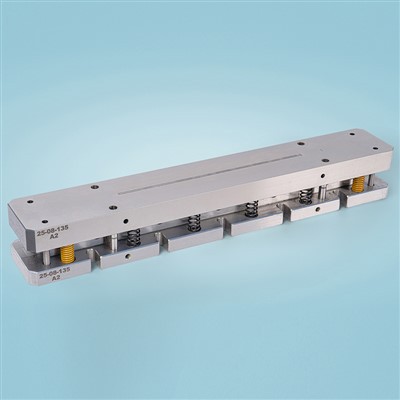
If you’re an aerospace engineer, manufacturing manager, or anyone who needs precision stamping dies for your next project, I’m here to help. We’ve worked with everyone from small satellite startups to major commercial plane builders, and we can design, build, and test a die that fits your exact needs. No one-size-fits-all, no corporate red tape—just a die that gets the job done right. Reach out to start a conversation about your project.
Fin Press Machine References
- Aerospace Stamping: Key Applications and Quality Requirements, Society of Manufacturing Engineers, 2022
- Titanium and Superalloy Stamping for Aerospace Components, American Society for Metals International, 2021
- Additive vs. Subtractive Manufacturing in Aerospace: Cost and Consistency Analysis, International Journal of Aerospace Engineering, 2023
- Springback Control in Aerospace Stamping Dies, Journal of Manufacturing Processes, 2020
Suichang Lvye Machinery Co., Ltd.
We are one of the most professional stamping die manufacturers in China, also support customized service with low price. We warmly welcome you to buy discount stamping die for sale here from our factory. If you have any enquiry about quotation, please feel free to email us.
Address: No. 402, Mudanting East Road, Miaogao Street, Suichang County, Lishui City, Zhejiang Province
E-mail: L528753@outlook.com
WebSite: https://www.suichanglvye.com/
