If you’ve ever stood next to a running industrial generator, the low, steady hum you feel in your bones isn’t just random machinery noise—it’s the product of every component being aligned just right. As a generator shaft supplier, I see it every day: even a hair’s breadth of misalignment can turn a reliable workhorse into a source of costly downtime, lost revenue, and even safety hazards. That’s why alignment tolerances for generator shafts aren’t just technical jargon—they’re the unsung rules that keep power flowing, whether you’re powering a factory, a hospital, or a remote construction site. Generator Shaft
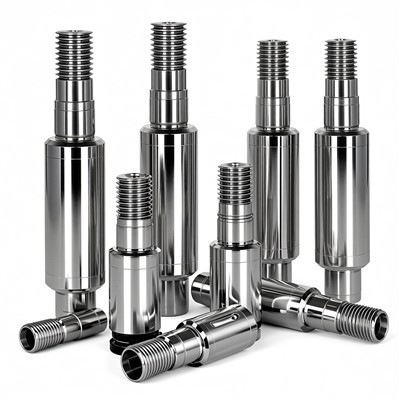
First, let’s break down what generator shaft alignment actually means. At its core, it’s the process of lining up the generator’s shaft with the shafts of connected components—most commonly the turbine or engine that drives it—so their rotational axes sit in a straight, smooth line. Over time, things shift: thermal expansion from operating heat, foundation settling, wear on bearings, or even just transport after installation can throw this alignment off. The tolerances are the specific ranges of misalignment that manufacturers and industry standards allow to keep the system running efficiently, without extra stress on parts.
To get clear on the numbers, it’s critical to distinguish between the two main types of misalignment, each with its own tolerance: angular misalignment and parallel misalignment. Angular misalignment happens when the two shafts aren’t tilted at the same angle—think of two sticks crossing slightly instead of running parallel. Parallel misalignment (also called offset misalignment) is when the axes are parallel but separated side-to-side, like two sticks sitting next to each other instead of perfectly overlapping. Both put uneven force on shaft bearings, couplings, and seals, leading to premature failure if they’re outside safe limits.
Now, what are those tolerances, and where do they come from? Most generator and component manufacturers follow standards set by groups like the International Organization for Standardization (ISO) and the American Society of Mechanical Engineers (ASME), which update guidelines based on decades of real-world field data. For most medium and large industrial generators (the kind you’d use for commercial or heavy industrial use), the standard tolerance for angular misalignment is 0.001 inches per inch of shaft length. Wait, let me make that concrete: if your generator and driving shafts are 10 inches apart along their length, angular misalignment should not exceed 0.01 inches of tilt. For parallel misalignment, the standard is typically around 0.001 inches per foot of shaft diameter. So a 12-inch-diameter shaft can have up to 0.012 inches of side-to-side offset.
But here’s where things get nuanced, and why as a supplier, I always tell customers to check their specific generator model before locking into these numbers. Smaller, portable generators—used for jobsite power or backup for a small business—have different tolerances than massive utility-scale generators that power entire cities. Portable units often have looser tolerances, around 0.002 inches per inch for angular misalignment and 0.002 inches per foot for parallel, because their components are more compact and built to handle minor shifts during transport. On the flip side, utility generators, which can weigh dozens of tons and spin at 3,600 RPM or higher, have far stricter tolerances—sometimes as low as 0.0005 inches per inch for angular misalignment, to handle the extreme forces of high-speed rotation.
Thermal expansion is another factor that can throw tolerances out of whack. When a generator fires up, its metal components heat up and expand—sometimes by several millimeters, depending on size and operating temperature. If you align the shafts cold (before the generator runs), you’ll end up with misalignment once it’s hot, because the shafts expand differently. That’s why the best practice is to align the generator while it’s at its operating temperature, or adjust the tolerance range to account for expected thermal shift. For example, if your generator is expected to expand 0.02 inches along its shaft length when hot, you’ll leave a small gap in cold alignment to compensate, ensuring you stay within the tolerance once it’s running.
I’ve seen first-hand what happens when tolerances are ignored. A customer of mine once installed a 500 kW generator for a food processing plant, and cut corners on alignment to save time. Within six months, their shaft bearings wore out prematurely, leading to a 3-day shutdown that cost them over $100,000 in lost production. When we did a post-mortem, we found their misalignment was 0.03 inches—three times the allowed tolerance for that unit. The fix wasn’t just a re-alignment; they ended up replacing the coupling and seals too, adding thousands more to their bill. That’s why I always emphasize to clients: alignment tolerances aren’t arbitrary limits—they’re the threshold between a smooth-running machine and a costly disaster.
So how do you measure alignment to make sure you’re within tolerance? The old-school method is a dial indicator, a tool that mounts to one shaft and measures the offset and tilt against the other shaft as you rotate both by hand. For larger generators, laser alignment tools are now the industry standard, because they’re faster and more accurate—able to measure misalignment in thousandths of an inch, even for shafts 20 feet long. When working with these tools, it’s important to follow the correct procedure: mount the tool properly, take measurements at four points around the shaft, and make adjustments to the generator’s foundation shims to bring the alignment within the manufacturer’s tolerance.
As a generator shaft supplier, I also make sure to provide clear alignment guidelines with every shaft we deliver. That’s because even the highest-quality shaft won’t perform well if it’s misaligned with the rest of the system. We also work with maintenance teams to help them understand that tolerances aren’t a one-time check—they should be re-checked after installation, after any major maintenance work, and annually for industrial generators. Over time, foundation settling, bearing wear, and even regular operation can shift alignment, so staying within tolerances is an ongoing process, not a set-it-and-forget-it task.
It’s worth noting that some industries have their own specific tolerance requirements. For example, generators used in hospitals or data centers (which can’t afford downtime) have even stricter tolerances than standard commercial generators. Data center generators often run 24/7, so any misalignment can lead to vibration that causes damage to sensitive electronics, or even trips the generator’s circuit breaker. Hospitals, meanwhile, need reliable backup power at all times, so their alignment tolerances are often 20-30% stricter than standard guidelines to ensure maximum uptime.
Another common question I get: what happens if you’re slightly over tolerance, but not by much? It depends on how much over, and how often the generator runs. A small, temporary misalignment of 0.002 inches might be okay for a generator that only runs a few times a year as backup, but a 0.005-inch misalignment on a generator that runs 24/7 will lead to vibration, heat buildup, and reduced efficiency—using up to 5% more fuel than a properly aligned unit, according to ISO data. That extra fuel cost adds up quickly: a 1 MW generator running 8,000 hours a year would burn an extra $10,000 in fuel for a 5% inefficiency, and that’s without accounting for parts replacement.
So how do you get alignment right in the first place? First, always refer to your generator’s manual—manufacturers design each unit to their own tolerances, so generic numbers are a starting point, not a rule. Second, work with a certified technician who has experience with generator alignment; improper adjustments can make misalignment worse, rather than better. Third, if you’re installing a new generator shaft, make sure it’s manufactured to meet the same tolerance standards as your existing components; as a supplier, we test every shaft we ship for roundness and straightness to within 0.001 inches, so you know it’s ready to align correctly.

At the end of the day, generator shaft alignment tolerances are about balancing performance, cost, and longevity. For facility managers, maintenance teams, and owners of industrial or commercial power systems, sticking to these tolerances isn’t just a technical requirement—it’s a way to protect your investment, avoid costly downtime, and keep power flowing when it matters most. If you’re working on a generator project and have questions about alignment tolerances, or need a replacement shaft that meets exact standards, don’t hesitate to reach out for a consultation. We’re here to help you get the alignment right, so your generator runs smooth for years to come.
Machined Part References
American Society of Mechanical Engineers (ASME). (2020). Alignment of Rotating Machinery. ASME PTC 19.3.
International Organization for Standardization (ISO). (2018). Mechanical Vibration – Balancing Specifications and Quality Criteria. ISO 1940-1.
generator shaft manufacturer guidelines, 2023. Industrial Generators Association (IGA) Technical Report: Shaft Alignment for Commercial and Industrial Units.
Ningbo Uni-drive Technology Co., Ltd.
Ningbo Uni-drive Technology Co., Ltd. is one of the most professional generator shaft manufacturers and suppliers in China. Please feel free to buy cheap generator shaft made in China here and get pricelist from our factory. All customized products are with high quality and competitive price.
Address: Industrial Site No. 6, Jingtou Village, Sanqi Town, Yuyao City, Zhejiang Province
E-mail: admin@uni-drive.com.cn
WebSite: https://www.motordriveshaft.com/
